Sunday, March 25, 2012

Entering the world of cloth

Apparently, with every new baby, I have to come up with some fabulously complex research project. With Alison, it was an obsession with learning how to brew espresso in the moka pot. Since I've already read all the sleep/early infant care books, I moved on to the enormously varied world of cloth diapering. Buying two sets of disposables at once brought on a case of sticker shock, and I suddenly was willing to entertain the thought of cloth. Last pregnancy I was briefly entranced by the idea of gdiapers, but just couldn't quite commit to trying it out. We all know why: the issue of human waste in the washing machine. That just sounds super gross. This all changed, however, once I learned a key fact:

The poop of babies who are breastfed is water soluble. 
That's right, people. Water soluble. That means that all you really need to do to get it clean is soak it in a lot of water and then stick it in the sun to get any residual stains out. The whole "human waste in the washing machine" thing was what left Pancho cold, but once I persuaded him of the whole "water soluble means it just washes away and you NEVER see it in the machine," he was on board to try, at least until we introduced solids.

So after tons of research and a complex cost analysis involve some single-variable calculus (no, really, I wrote a formula that told me how many diapers I had to change with cloth before I broke even on my investment), I decided to try the Best Bottom Diapers, which is about as close as I can get to the convenience of disposables without washing a ton. Basic concept: a snap in cloth inner liner into a PUL (waterproof) outer. You can wipe off any small overflows onto the outer liner and just snap in new inner liners. Everything goes into a dry, waterproof bag (that is also washable) for laundry day in 2-3 days. Then a brief soak, a wash, a double rinse, and out in the sun to dry.

I get an incredible kick out of watching the stains magically disappear in the sun. It's almost worth it just for that little piece of mundane magic. That said, I still have about 55 days left before I break even...

Sunday, January 29, 2012

Our new arrival

There's nothing like a new baby to prompt you to pick up a blog you haven't posted in for over a year. So here she is: Audrey, just born two weeks ago and a really sweetheart with poochy cheeks.

Things are not quite crazy yet, because Audrey sleeps all the time, so that sense of double-demand has yet to befall me. Alison is taking the new baby like a champ and started heavily investing in bathing and diapering her baby doll, as well as taking all of Audrey's diapers out of their basket and strewing them around the house...and then finding them all and putting them back in (sometimes). "Alison kiss/hold her?" and "I see her?" are common questions, and she has made up a song that she plays on the piano, the lyric of which is "Audrey is a great baby"...I think. So all is calm so far. The true sleep deprivation has yet to strike, and Pancho  goes back to work tomorrow (yikes!) so Alison's morning playmate will for the first time be gone. That scares me.

I'm surprised how easy it is to love two just as much as I loved one. There is no diminishing or competing in my heart or a sense that I have a favorite. They are both my favorite, both my girls, my pies of cuteness. I am so thankful for that.

Tuesday, July 13, 2010

Reductive Research

I'm continuing to work my way through Wendy Belcher's workbook for academic publishing and have found much helpful advice.  Still, I have noticed a theme that is increasingly disturbing me: the reductive modus operandi of academic research culture.  Successful writers, Belcher tells us, know when to stop reading.  Fair enough.  They also know how much to read, how to mine sources for only the relevant bits that can go into their own work, and how to "reduce articles to their essence", and how to read whole books in 45 minutes (!).  As journal articles and books proliferate to an incredible degree* in an age where publishing records determine job promotion and retention, professional quality research must bow more and more to summary and reduction, rather than deliberative study.  How can we study when there is so much to plow through just to cover our bases?

I already feel compromised when I merely mine a book for what interests me, rather than attend to the argument of the whole as something worthy of study in itself, regardless of whether or not I can use it.  I see the same in academic seminars: we tend to ask questions that feed into our own pet interests, rather than engage in a proper discussion about the paper just given and its own interests.  I myself have often asked questions that went something like, "You said x which seems to relate to y [which I happen to be interested in] in z way.  Do you think that's true or can you say more about that relationship in light of x?"  Most junior scholars blow this question (and I truly don't mean it as a trap), and senior scholars tend to brush it off...perhaps rightly so.  I have rarely sat in on discussions in academic seminars that were lively and engaged around a more or less single topic of study, rather than a wide-ranging conversation.

So I am as compromised as the rest of us, but I think what I really want to do is study, not merely collect and collate and create some new idea out of all the old ones.  The question is, how do I study when I am under the pressure of time to produce and participate in precisely the culture that militates against study?  I don't want to reduce others' nuanced thoughts and work to a paragraph abstract, any more than I want my hard labor so reduced.  Yet, that is what we are taught and encouraged to do.  More and more I am grateful for the stability in my teaching curriculum, which furnishes an opportunity to truly study, widely and deeply, in some of the texts that best reward that kind of patient work and attention.

* Lindsay Waters talks of a near 100-fold increase in academic publishing in the last 50 years or so, if I remember rightly. I'll go hunt up the statistic, but it was quite shocking.  Simultaneously, where humanities books used to sell a minimum of 1250 copies, now publishers are lucky to sell 275 copies.  There are just too many books and articles driven by the need to keep a job, and not by the fruit of deliberate study.

Friday, June 25, 2010

Resolving a practical question, Aquinas-style

Quaestio: Whether or not it is the case that my research assistant, R, is irreplaceable.

Obj: It seems no.  We must distinguish between her replaceability and the ease of her replacement. While a smart cookie, R's skillz match those of competent researchers elsewhere. The difficulty lies in finding said researchers during the summer, and convincing them to work for only 8.50 an hour. But even in that case, it remains possible to find a replacement, though perhaps unlikely.

Obj: It seems no. R can retain all of her virtues, and retain them personally, yet it still remains that those virtues find their source in an omnipotent Provider.  Thus, because she participates but does not instantiate those virtues, she is, by nature, replaceable by that in which she participates.

On the contrary: David confirms, "For you created my inmost being; you knit me together in my mother's womb. I praise you because I am fearfully and wonderfully made; your works are wonderful, I know that full well." [Ps. 139]

Though all R's skills and virtues can be found elsewhere, she is nevertheless irreplacable as a beloved creature of God, made by grace for His pleasure and delight and for ours as we live in Him.

Reply to obj. 1: One must distinguish between the replaceability of R's skills and virtues with the replaceability of her person.  As one's person is not reducible to what one does, and as one is in unqiue posession of one's own person, it then follows that R in se is irreplaceable, and that that sense of irreplaceability, since it resides in being and not in ephemeral doings, is actually the most important of all.

Reply to obj. 2: Of course God is eminently able to provide me with either Himself or another of His creatures that participates in many if not all of R's virtues.  Who wouldn't want the Logos as their research assistant?  That God possesses what we only participate in does not make us replaceable.  In fact, that we exist at all and therefore can (and always already) participate in what God possesses uniquely confirms our irreplacability as creatures of utterly superfluous grace. The divine economy is always one of grace and superaddition, not efficiency.  All that has been made is by its created nature gratuitous; by extension, that which has been made cannot be truly replaced by its Maker, since the difference between possession and participation is too absolute.

Tuesday, June 15, 2010

Freshmen Pre-Reading

In the summer of 1997 I graduated from high school, passed my 18th birthday, and saw with a fellow soccer player my first rated-R movie: The English Patient. I remember the post-practice itch on my shins from the shinguards and propping my legs up on my over-sized practice bag, bulging with cleats, extra socks, water bottles, hair bands, braces for ankles, my left knee's custom-fit carbon exoskeleton, athletic tape, and a spare turtleneck still hanging around from the winter season. We had come to the theater from a day at soccer camp, and we smelled of sweet girl-sweat and grass and chlorine.  We were practically alone in the theater that afternoon, but we still covered our eyes during the sexy parts and took turns peeking to see when it was safe to look again. I remember liking the movie for its artsy-ness (the comparison of a desert to a woman's back still lurks in my imagination), but I don't think I really understood it very well.

A few short weeks later, I received notice from my college-to-be that they were asking the entire freshman class to read Michael Ondaatje's The English Patient to be discussed together during freshmen orientation.  I read it, but can't remember any provocative or interesting conversations that it started. The fault for that failure lies less with the book than with freshmen, who (myself included) were far more interested in comparing SAT's, taking internet personality quizzes together that purported to tell you what kind of medieval personality you had (White Knight, for the record), and hanging out in the dorm hallways lighting Peeps on fire.

Apparently, assigning pre-reading has become common among the top-tier colleges, and a recent report by a "back to the classics" association of scholars (as far as I can tell) surveyed the choices.  13 years ago, my alma mater chose a novel that had been premiered in the same summer as a movie, thinking perhaps that such a choice would be "relevant" to the students. From what I can see of the study, the principles of selection employed now-a-days are pretty similar.  The overwhelming majority of books assigned were written in the last decade, many of which were bestsellers or of great topical interest, such as Michael Pollan's The Omnivore's Dilemma and Khaled Hosseini's The Kite Runner (also a 2007 film).  The only four pre-1900 books read were Huckleberry Finn, Walden, Frankenstein, and the Communist Manifesto, read at only 6 of 290 programs.  The report, claiming in passing that they could detect a liberal political bias in the selections, largely aimed at making the colleges more self-aware about how their selections match up with their aims and whether or not books of recent topical interest (and frequently less challenging reading) can fill the bill as well as books of proven merit (in other words, those regarded as classics).

One aim of such a program was to have at least one book in common amongst freshmen from various curricular backgrounds and who will quickly specialize.  In the Inside Higher Ed piece that reports this story, one college official objected that the program aimed at creating community, not a common foundation for an intellectual conversation.  Another noted that easily read books covering current events are essential, since the students won't necessarily have the professors guiding their conversations. What seems clear is that while the Freshman summer read is a popular trend in higher ed, precisely what it is aimed at achieving is a bit more murky.

This caught my eye because a colleague of mine recently assigned his incoming freshmen to read Mortimer Adler's How to Read a Book.  Love Adler or hate him, you have to admit that you can learn a lot from him about what it means to seriously study (and not just quickly ingest and spew for a test) a book. Students who have struggled with reading slowly during their first semesters at college have emerged from reading this book with dewy eyes, a sigh of relief, and renewed enthusiasm, exclaiming, "If only I'd read this sooner I wouldn't have wasted so much time re-reading ineffectively!" Unlike a summer read of the Kite Runner or even Huck Finn--an exercise which may, or may not, inculcate critical thinking, community, or whatever else they're supposed to do--a read of Adler's book actually prepares you to be a student in an explicit way. So few college freshmen come with the ability to read and analyze a complex book well, even on the most literal level. I can't remember how good of a reader my 18-year-old summer self was, but my guess: not that great, valedictorian or no. I can't remember much of the English Patient (even with the movie's prompts), but I don't think it deserved the burden of trying to independently usher me into "critical thinking", "community", or "issues". I'd rather take the commen-sense advice of Adler, and then get the advantage of adapting it with a faculty mentor to how I think and learn. So kudos to my colleague, for that's exactly what he's doing with his students as they prepare to slog through the classics and the not-so-classic.

Saturday, June 12, 2010

Holidays as a Moral Imperative

A holiday is a luxury, and yet I feel in a small sense morally obliged to take one if I have the means to do so.  Taking a holiday for me is like having wine at dinner; it goes beyond necessity into a kind of properly human virtue. Wine bespeaks festivity, a holiday, leisure. Both are jolly with a delight in superfluity.

Leisure poses a challenge to me. I seek out activity--usually intellectual and relational--and find it difficult to rest. During Lent I gave up reading blogs and other forms of internet-delivered news. I was surprised to find the wheels of my mind restlessly spinning. I'm tempted to pile on metaphors here: I kept looking for sneaky ways to supply grist for my mind's mill, fodder for thought. My mind felt like a sewing machine running and clacking and whirring but without any thread in the needle. Josef Pieper writes of restless activity as a species of sloth, which masquerades as the virtue opposite to a dull indolence. For Pieper, the opposite of sloth is not busy-ness, but leisure. My inability to quiet the vain chatter of my mind in the darkness of the nights as I nursed Al shows that this is a sin to which I am prone.

My busy indolence has come even more to the foreground with parenthood. As a mother who is trying to work and be present to her baby, I feel the ticking of time passing as steady forward pressure on my back. If Al is asleep, a million things deferred cry for my attention, and I rush from dishes to laundry to emails to paperwork until she wakes. I wonder sometimes if working is a red herring here, though. I feel "on call" for Al at any time, day or night, and I never know when she will need me, so I rush my other tasks to be ready and available and fully present. I suspect non-gainfully-employed me would feel little different.

So all the more, a holiday has become a moral imperative. It is something I ought to do. And yet, to do it puts another task on my list: planning! But what is another task, really? The list is never all crossed off anyways. I need to learn to live well with my list, and not make myself a slave to its seeming demands.

Thursday, June 10, 2010

Side-Sleeping

She squirms, scrunches her legs up, knees crooked, and tilts to her right. Always to her right. In a little while, she will dig her face into the mattress, twisting her torso even more, but the end of the mattress blocks further rotation and she is, for the moment, stymied. Slow rhythmic breathing attests to the singular fact: all this has been done while she is yet asleep. Soon, she will slowly uncurl; it is barely perceptible in the grey of our darkened bedroom, but you suddenly are sure that her arm has unbent, her hand unfurled like a flag of surrender. If you're unlucky, her frustrated attempts thrust consciousness upon her and she begins to cry herself awake. If you're lucky, she sighs and continues to sleep. But if you're very lucky, she does it all over again while you smother giggles and try to convince yourself to stop watching and go to sleep.

Product versus Process

While trolling through some notes on book and article publishing, I discovered an old book recommendation for junior faculty: Wendy Belcher's Writing Your Journal Article in 12 Weeks (the intro and first chapter are available as free samples from the publisher's website).  I ordered it from our library and printed out the samples and have been working through it ever since.  It's tempting to think of oneself as above "how-to" guides, but frankly, I'm not that unique nor the exception to the rule.  This is a recurring theme in my life these days: I'm not so different from everyone else, and that's just fine.

The most powerful epiphany I've had so far came from an exercise where you scribble down the emotions you have about writing.  I immediately separated those emotions into two categories: the writing I do for my job and the writing I do for myself.  Writing for the job elicited a host of negative feelings like guilt, burden, isolated, paralyzed, inadequate; writing for myself, however, turned words like joy, freedom, silliness, eagerness.  Why such a difference?  Clearly, I like to write, so why does it all turn so sour when I think of writing in my area of most intense study?

I realized that what sabotaged my professional writing was my preoccupation with the product.  Rather than enjoying the process, I was plagued by fears about the outcome.  Would it be publishable? In the right places? Will it "count" for promotion? Will it undermine publishing my book (currently on hold)?  When I write for myself, I am at leisure, enjoying just rolling words around the page, crafting them (at least a little bit), making jokes.  I am unhurried and free.  Nothing constrains my choice of subject, my length, or my quality.  I can just write, and delight in it.

To bridge this gap, I have decided to stop obsessing about what's "best" to publish, and just focus on what I'd enjoy writing up.  I will pray to be faithful and truth-loving in my process, and pray that God would make the product glorifying to Himself, regardless of what it does for me.  I know I cannot control outcomes in the lives of my students or my family; now I realize that I cannot do so for writing either, no matter how much it seems that it is I alone who make this product.

Wednesday, June 09, 2010

A Scale is Never Neutral

This morning, I walked into the women's restroom in our administration building and was surprised to find a scale tucked into the corner. My thoughts went something like the following:

Why is this here?
Is there one in the men's bathroom too? I bet there isn't!
Oh, calm down - maybe someone is just trying to lose some weight and this is helping her.
But still! how is this not a suggestion to every woman in this building that she needs to measure up and might be failing?
Who can I complain to about this?
Wait, I wonder how much I'm weighing these days, after Al's birth...hmmmm.....
Wait, if I weigh myself, am I showing myself totally hostage to an image-based assessment of myself?
Relax and stop overanalyzing - just have a look at how much you tip the scale
[check to see if I can read it without my glasses]
Shoes or no shoes? No shoes.
[Result: just shy of 150, near my pre-pregnancy weight]
Hunh. That was unexpected.  I weigh practically what I weighed before, but still have lots of new pooches.  How does that work? Will they ever go away?
Should I feel guilty that I weighed myself?
...Well, at least now I have something to write my 500 words about!

As a woman in this culture, a scale is never neutral; it poses a dilemma and a temptation. 

During most of my pregnancy, I ignored the scale except when at the doctor's office.  Since I lost weight early on due to feeling sick to my stomach, I was happy to be gaining weight, happy to eat just about any full meal, no matter how atypical.  Somehow, In 'N Out burger never seemed to pose problems to my appetite, even though home-cooked chicken stew was noxious to me.  I'm not even sure what I weighed towards the end (I think just over 170, just shy of 25 pounds of gain) and I didn't care what I weighed in the first 6 weeks after birth. But after those first two months, people start wondering aloud at you about your weight. My dear mother, bless her, started hinting that we should get out and walk the pounds off together. I was (and still am) still wearing maternity clothes and began to wonder when (and if) I would get a semblance of my body back. The necessity of buying new (and bigger) clothes loomed before me. Even affirming comments ("wow, you already look great!") prompt internal criticism ("I guess she can't see the pooch, and the extra loads in the legs and arms that tighten my sleeves and necessitate wide-leg pants"). 

My body is not only a bit larger; it has changed its overall shape from pear to hourglass/apple. After years of dressing as a "pear", I no longer know how to dress myself. Nursing has wreaked havoc on my ability to fit into tops: to get shirts to fit on my ample top (and be easy to nurse with), they have to be huge on the bottom as well as long for my lengthy torso.  Hence, I'm still wearing maternity shirts! And let's not talk about bathing suits beyond the observation that with a long back and a nursing upper half, the tankini is the only option.  As there are almost no modest tankini's with the ability to support my upper half, hoochie-mama here I come. 

Nursing mothers typically need to consume lots of water and about 500 extra calories a day. I'm hungry all the time, and mostly crave sweets. Just drinking water doesn't do it for me, but give me some juice (or even better, a Jamba Juice!) and I'm in heaven...until the extra calories pull me back to purgatory.  Now I feel that I have "watch what I eat" and just be a bit hungry all the time so I don't gain weight.

So here I am, an educated, confident woman, slightly obsessed with her weight and body. Much as I know my own value in the sight of God and those who love me is secure, I am not immune to the siren song of the scale and what I think it purports to say about me. 

The dilemma posed to me was to know or not to know a measure that says little about my overall health or about my self.  Idle curiosity versus a pretense of indifference. If I truly were indifferent, it would be no dilemma.

The temptation posed to me was to use the scale's measure as a measure of things beyond my weight: of my self-discipline, of my time management, of my desirability to Pancho, of my professional stature (sadly, pudgy women professors command less respect). It could never have been registered as anything but a rebuke.  I could have weighed in at my college weight (135) and still felt chastened. 135? Nice going! Now you have to weigh even less to lose this extra pudge! That it doesn't matter what the scale says shows how I already tie the scale's measure to a critical view of my body and my self. In that sense, the scale only furnishes me an opportunity to articulate what I already think about myself. It is a mirror only in the sense that it shows me what I already imagine myself to be. Thus, it is no mirror at all, but a canvas upon which I paint my self-caricature.

Freed from sin and from the wounds inflicted on me by our image-obsessed culture, I will one day relish tiptoe-ing onto the scale out of a true and holy curiosity that can look at any number as a fact about the world and about myself to be celebrated and enjoyed. I will be able to walk into a bathroom with a scale and regard it as a child, who will feed a quarter to to that giant scale staunchly stationed on the train platform. Neat! I get to see how much I weigh - how fun!

Tuesday, June 08, 2010

Writing Retreat

My university is generously sponsoring a writing retreat this week on campus, and, thanks to Grandma and Abuelita, I am attending all three days.  In fact, I'm there right now.  I have realized that I am so woefully out of practice writing that I'm having an inordinate amount of difficulty just setting down to it.  Thus, each day, one of my goals will be to write at least 500 words about anything.  Anything.  Just to write will be enough.  To give myself some bare accountability, I will post said 500 words each day on this blog.  

Sorry about that!

I have to run back to Al now, so my first day is a bit of a wash, since I only re-drafted an old post on coffee (below) and wrote this.  I will try to get a few more words in later today while Al sleeps.  If that is to no avail, I will START my writing day tomorrow with my 500 words. NO MATTER WHAT. 

See you tomorrow!

More on the Moka

Thanks to Jones Coffee Roasters of Pasadena I've been enjoying some pretty top-notch espresso made in the moka, and I've learned a lot from making a couple of hundred cups in this method so far. My rubber gasket was looking pretty worn, so I replaced it two days ago and discovered something interesting:
The newer the gasket, the lower the temperature of the flame and the less packed the grinds there needs to be.
Also:
Once you've brewed your preferred serving size in the moka pot, pour immediately. The best part of the brew occurs in the first seconds. This may mean that more may sputter out after you pour and that you make larger servings than you drink. Forget about the leftover coffee and throw it down the drain.
In fact, I now believe that the fit with the gasket makes quite a lot of difference to the finished result. Here's why: after I fitted my new gasket in, I made myself an espresso the way I always do, and suddenly the pot behaved very differently. It was back to sputtering and spitting quite early on in the brew, just as it had at the very beginning when I was learning how to use it. Sputtering in this way usually leaves you with boiled coffee - not terribly yummy. I prefer to have the brew escape in a slow, steady fashion. It's safer too! When it did this at first, I blamed the water temperature and the grind, but now I think it was a matter of temperature and amount of grinds.

For your reference, an earlier fact-finding mission on the web discovered this helpful link. And my recent read of acclaimed coffee guru Kevin Knox's (of The Coffee Review) book Coffee Basics has panned the moka pot as a general killer of coffee in comparison to the virtues of the French press, Aeropress (his and our favorite for best coffee taste), and paper cone filter methods. From Knox I also learned the true shelf-life of coffee and the true shelf-life of ground coffee (hours if not in an airtight container, about a week max if in an airtight container away from light and heat). Since I preferred buying moka grind (thinking that it was the key to the perfect moka brew), Knox helped me see that I was drinking stale coffee within a few days of opening the canister. So a new tip:
If you buy ground coffee, store it in a airtight canister in a cool, dark place and drink it within a week, or sooner. Or just don't buy it ground.
Experience proved him right: I had a week-old Jones Cara Mia espresso in the canister and compared it to fresh ground from that day. There is no comparison. The freshly ground coffee was so dramatically superior I began to wonder why I drank the other instead of, say, Folgers or some other such horror. But I simply can't make it through 1/2 lb. of coffee in a week (especially not as a nursing mother). So I'm a bit stuck: either I waste coffee (and take a trip out to Jones every single week) or get inconsistently ground coffee that might affect the quality of the brew (the jury is still out on that one). My current halfway house idea is to buy the 1/2 lb. at Jones (the smallest increment they sell), and then have them grind HALF of that, and take the rest home whole bean. Next time, Jones, next time...

When all is said and done, though, using a moka is a finicky way of brewing yourself coffee and tends to burn the coffee at least a little (and sometimes a lot, if you don't watch out or don't know what you're doing). Which is just as I'd like it to be. Who wants an easy way to brew? That takes half the fun out of making yourself some coffee. I want to fiddle and faff and have a good half-dozen mini-steps or tips to make it come out juuuuust right.

Coffee is no mere beverage or energy drink; coffee is leisurely activity.

Friday, May 21, 2010

Daddy's Dodger Girl

Al has been taking forever to get to sleep lately, so after a long nursing, I passed her off to daddy to finish the night-night routine. But, a Dodgers game is on, and lo and behold, what do I see but daddy and little girl peeking out around the hallway at the end of an exciting inning. Al had been pretty drowsy, but all of a sudden she realized the game was on and jerked awake, alert to the crucial part of the inning. Daddy!!! It's a half an hour later now, and I hear her sputtering in our bedroom, wanting to watch the rest of the game. I should have just let them watch the game, instead of giving daddy the "are you kidding me?" look and shooing them back into the boring, dark bedroom while the Dodgers took the lead during the 6th.

I guess she's daddy's little Dodger girl. My fault for dressing her in the Dodgers shirt this afternoon.

Saturday, May 15, 2010

Laughing takes work

A few minutes after Alison's first laugh, we recorded the following:


Clearly, it was just a one shot-deal, and the first of many times that we realized that while she always laughs in company, she never laughs at what we find funny. Later that day, we did manage to catch her at it, but only with quite a lot of effort on mama's part:


In fact, when we laugh, it tends to startle her into solemnity. So how exactly did she learn how to laugh???

A meets Daddy

Tuesday, April 06, 2010

Whither my girl?

My chatterbox seems to have gone into hiding. From when she was only a few weeks old, you could hold her head in your hands and coo back and forth with her for ages (ages = 15-20 min in baby-time). Early last week she began to increase the volume of her hiyas, gurgles, tongue-rolls, and ha-uuiuuhhhs, but she's gone strangely quiet of late.

It's hard not to ask myself if I did something wrong. Did I make her more passive by wearing her in the sling too much? Am I not playing enough or engaged enough with her? Am I letting her sleep too long because it's convenient for me? Did we shush her too much? ... I suspect these to be foolish questions driven by my perfectionism, not by her good.

Or is she just becoming more interested in observing the world and therefore splitting her time between quiet observation & playing with lips, palate, and tongue?

I don't know her well enough to say. She is my enigma as well as her own. We stare at each other: I, wondering who I'm seeing; she, wondering at her seeing, but perhaps not yet at me.

Friday, April 02, 2010

The Sea

It seems that sometimes, for her, existence is so overwhelming that it feels like a burden, and then she cries and cries, sputtering, choking, gasping for air like a drowning woman. And I lean over her, wanting to throw her my self as a lifeline, but perhaps offering her only more waves of the sea to buffet her little soul. She stares at me with incomprehension widening her eyes and grimacing her face. She is dry, recently sated with food, and not in physical pain, but she has been gripped by something outside of her control, let alone her understanding. To be held is her deepest desire; all else is the vast, heaving sea: my murmurs and little touches, my fingers stroking her forehead, my eyes locked woth hers, my arm cradling her body in the car seat, all wind and waves to her. But still I must buffet her with my presence, for I have nothing else to give. And since she has been given to me and I to her, I know that is enough to be faithful to the call that is also the gift. I cannot mend this plight, but it is not mine to mend. It is mine to bear with her, and hers to bear with me.

Thursday, January 21, 2010

Jesus didn't have Pampers

You don't really ponder much at 3am in the morning with a whimpering baby trying to communicate her needs to you, but as I changed her second diaper in 30 minutes...

(aside: she's really sneaky about doing her business right after you changed a diaper that was merely wet but you felt too guilty to leave on her, even though Pampers is so darn efficient at wicking moisture away from the skin you weren't sure she was urinating at all at first)
...and marveled groggily at diaper technology...
(in a stroke of brilliance, Pampers has a little stripe that turns green when wet, thus notifying you when you need to invest another $0.23 or so in their remarkable company. Al is quite the avid investor)
I realized that Jesus didn't have Pampers.

And Mary was taking care of a newborn in a stable without easy access to a washing machine or a host of eager relatives willing to help her in those early days (they didn't even have family housing, for heaven's sake!). So the Word who created all that there is humbled himself to the point of periodically sitting in his own waste and having to cry out to one of his own creatures for help and relief.

We burn through our wipees and cloths and disposables and desitin at an alarming rate with a little one who eats every couple of hours or so and digests what she eats in 90 minutes; these luxuries are in handy little dispensers next to anti-bacterial hand gel for mommy and daddy after the clean-up is through. We call this a stressful period of life with a newborn, but oh how easy it has been made! How often did Jesus have to chafe in a soiled diaper of some sort due to poverty, I wonder? How often did He whimper and cry for relief of His discomfort?

The nitty-gritty of the humility of the Son in the Incarnation strikes me more and more. How often I have agreed that for the Son of God to become a baby is to become so vulnerable, and yet the depth of that vulnerability is in the details, not in the easy generalization. Jesus required near-constant care and attention to the most basic of needs for living creatures, every day, for months on end. He who is life to us chose to need a young woman to sustain His body and to train His limbs, to teach His lips to smile and His mouth to laugh. As I care for our little one, changing yet another diaper and wiping up half-digested milk from her face, I remember Him and worship.

Such is the glory of our God!

Thursday, December 31, 2009

Christmas and other babies

Christmas was low-key - we just hung out with baby while the rest of the family were elsewhere celebrating. They eventually brought us some of the dinner and cuddled Al while we ate it. I cried while listening to Sixpence None the Richer's "Last Christmas". I thought more about the vulnerability of the Son as a wee baby and the incomprehensible humility of that (diapers! spitup! can't hold his own head up!). I thought of the women of the past and around the world who may have lost their baby in the kind of labor I could have had sans drugs, and the blessing of the knowledge we have of the human body and how to help labor along.

I remembered Eve's "with the help of the Lord I have brought forth a manchild" - not a mere platitude of thanks. She had never seen a baby born before; no experienced mother was available to explain to her how to help her bear the pain and what the process would be like. More and more I wonder if "the help of the Lord" was quite direct and engaged in an embodied fashion of some sort--an incredible mercy in what appears to be the grip of the curse. In Paradise Lost, Eve contemplates killing herself so that she won't spread the curse to other humans born of her, but our God is bigger than mere damage control. Amazing. Still thinking about this - Eve and Mary and the seed of the woman.

You can call her Al

Vital stats:

  • DOB: 23 December, 3:26am
  • 6 lb. 13 oz.
  • 19 1/4 in.
  • 25 hours of labor beginning around 2am when Ladybug sprang a leak; took 18 hours to get to 4cm and then held there while contractions got stronger and stronger and I got tireder and tireder and Al went nowhere fast; last 6-7 hours were mercifully helped along by drugs with about 45 min. of pushing at the end (because the midwife was slow in getting ready to catch).
  • copious quantities of light brown hair
  • daddy's feet
  • long fingers
  • can do daddy's raised eyebrow trick
  • perhaps right-handed (oh well)

Thursday, July 23, 2009

Summer Gardening

I believe it is well known that, in contrast to those of you with green thumbs, I have a black thumb of death. I am very good at killing plants, whether through neglect or through over-watering or what have you. Pancho, however, thrives on yard work, and my mom loves growing things, so between the two of them we ended up with 4 tomato plants, 2 bell peppers, an assortment of lettuces and herbs, a dwarf lemon tree, and a frankenstein-like apple tree with 6 different varities plumbed in, all to nurture into fruitfulness.

The lettuces thrived faster than we could eat them, especially after I went off leafy veg early in the stages of my own nascent fruitfulness. You will notice in the picture that one is actually taller than my head. We have now learned not to plant too many lettuces, and that they love the spot right next to the apple tree, but aren't too keen on being on the back porch step. So I didn't manage to kill off these hardy little guys, but that's largely because the sprinkler system seemed to give them everything they could ever want.
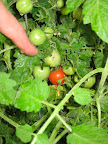

Our other success was the tomatoes, which apparently thrive whether you neglect them or shower them with care. We were pretty chuffed when they just seemed to spring up without much help, and we glowed with excitement when we saw those first glimmers of ruby red.

Then, they started taking over the path and growing taller than me standing up. (You can't really see this, since the vines got so heavy they plunged back to the ground or looped around each other.) If you walked along the path, you inevitably were tinged with a slight shade of chartreuse and emerged faintly scented with tomato. I would have stripes of color on my arms and legs pretty much every time. I learned quickly not to walk back there with khaki pedal pushers on.

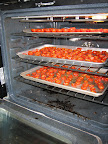
Given the bumper harvest, I'm thinking next year we'll stick with 1-2 plants, instead of 4. I'm running out of ideas for what to do with so many tomatoes! This morning, I took a boxful and am now slow-cooking and also oven-drying them all. Although people say that you can just individually freeze cherry tomatoes, I don't quite have the freezer space for that, so I thought taking some of the water out via drying would help. Apparently, I can put the results into a jar with olive oil and herbed vinegar or (for longer storage) in an airtight container and into the freezer. So that's why, on what promises to be a hot day, I am running my oven on the lowest possible temperature and why the slow cooker was banished to the dining room floor.

And I still have another box left...and more coming...

And lest you think that the black thumb of death has found new life, let me assure you that I have substantially weakened (if not killed) two expensive golf-ball plants, and the lemon tree is sick.